

Have you ever wondered why high-speed car accidents are so incredibly devastating to the human anatomy? The simple truth is that our bodies never evolved to handle the sheer kinetic energy generated by modern machinery. While vehicle technologies have advanced significantly with airbags, crumple zones, and automated breaking, the human skeleton remains fundamentally identical to that of our ancient ancestors who moved at a maximum speed of a sprint.
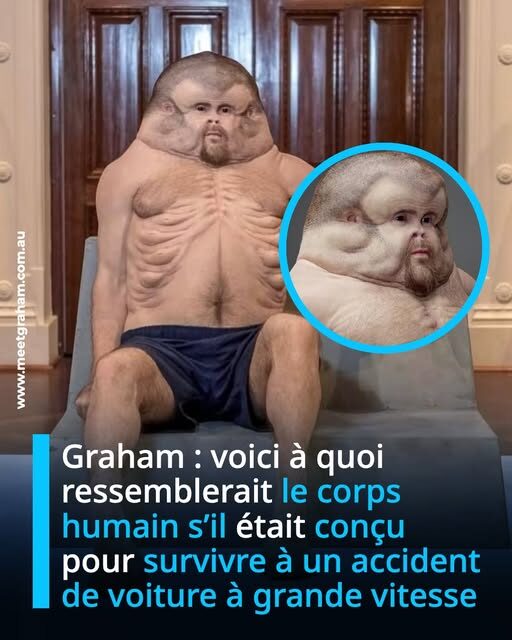
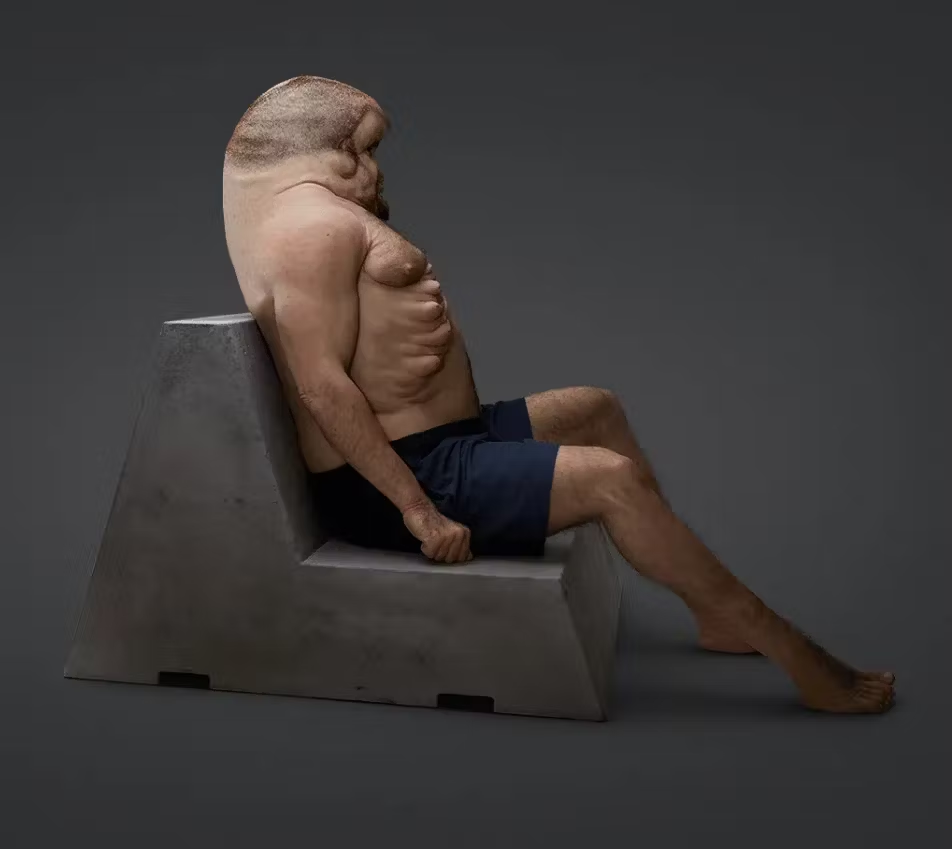
To bridge this unsettling gap between biology and engineering, Australian researchers teamed up with world-renowned sculptor Patricia Piccinini to design Graham—a hyper-realistic, interactive sculpture that answers a compelling question: What modifications would the human body require to survive a high-speed vehicle impact?
The result is as mesmerizing as it is deeply disturbing.
Anatomy Designed for Impact: Inside Graham’s Biology
Every single unusual feature of Graham’s bizarre appearance serves a strictly practical, clinical purpose. He represents a roadmap of our physiological vulnerabilities on the road.
1. A Built-In Helmet (The Domed Skull)
Our brains are essentially floating in fluid inside a fragile casing. In a collision, the brain slams into the interior walls of the skull, causing severe trauma. Graham’s head is massively enlarged with a thick, helmet-like skull. It features built-in crumple zones and internal cavities that absorb and disperse impact forces long before they can reach the brain.
2. Elimination of the Neck
The human neck is one of our most fragile structures, highly susceptible to violent whiplash during sudden decelerations. Graham bypasses this vulnerability entirely by simply not having a neck. Instead, his ribs extend all the way up to his skull, bracing his head and protecting the cervical spine from snapping or flexing dangerously under pressure.
3. An Organic Airbag System
Graham’s torso looks heavily distorted due to an over-engineered rib cage. His chest is broad and reinforced with extra layers of bone, cartilage, and fat. Most uniquely, he features sack-like pockets of fluid between each rib that act exactly like miniature, biological airbags. Upon impact, these sacks absorb kinetic energy, preventing his vital organs—such as the heart and lungs—from being crushed.
4. Thickened, Shielded Skin
Normal human skin tears easily and offers zero protection against friction or blunt force. Graham’s skin is drastically thicker, tougher, and reinforced with subdermal fatty tissue. This serves as natural armor against abrasions, windshield impacts, and debris punctures.
5. Multi-Directional Lower Limbs
Pedestrian and driver leg injuries often involve broken knees and shattered ankles. Graham’s legs are modified to allow for swift escape or impact resilience. His knees can bend in multiple directions to prevent snapping, and his lower legs feature extra joints, mimicking a kangaroo’s anatomy. This allows him to spring away from oncoming vehicles if he is acting as a pedestrian.
The Evolutionary Mismatch
Originally launched as an interactive public safety campaign by Australia’s Transport Accident Commission (TAC), Graham has evolved into a global symbol for road safety and biomechanics.
He serves as a shocking visual reminder of our fragile biology. Human evolution takes millions of years, yet we have gone from walking to traveling at speeds exceeding 100 kilometers per hour in just over a century. Graham does not exist in nature because nature never anticipated the automobile.
Why Graham Matters for Modern Drivers
Looking at Graham can be uncomfortable, but that discomfort is precisely the point. He forces us to realize that when we step into a car, we are fragile beings navigating an environment designed for machines. Until our infrastructure and driving habits match the limitations of our natural anatomy, we rely entirely on seatbelts, speed limits, and defensive driving to keep us alive.