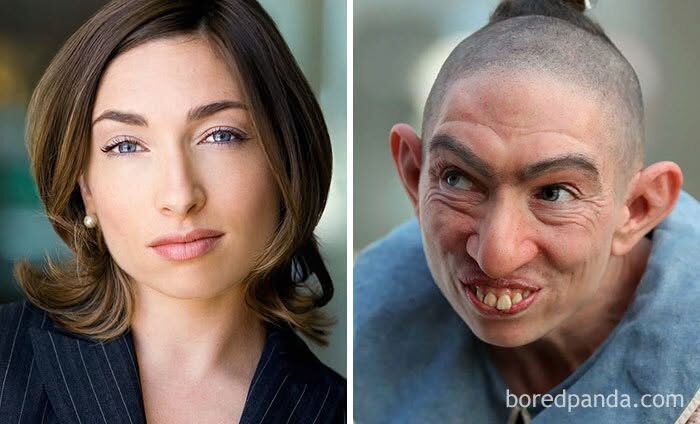
When we watch a movie, it is easy to get lost in the story and forget that beneath the terrifying scales, rotting flesh, or dramatic age lines is a real, familiar actor.
While CGI has taken over much of modern filmmaking, nothing beats the tangible, jaw-dropping artistry of practical special effects (SFX) makeup. Talented prosthetic artists spend hours gluing, painting, and sculpting on actors’ faces, completely erasing their identity to bring iconic characters to life.
Here are some of the most unbelievable before-and-after transformations in cinematic history that prove practical effects are a true art form.
1. Ralph Fiennes as Lord Voldemort (Harry Potter series)
- The Transformation: To become the Dark Lord, Fiennes didn’t just need digital nose-removal. He spent hours in the makeup chair having his eyebrows blocked out, veins meticulously hand-painted onto his skin, and gelatin prosthetics applied to give him that pale, snake-like appearance.
- The Behind-the-Scenes Reality: Fiennes actually requested a quicker makeup process because he hated sitting still, prompting the SFX team to streamline the application to under two hours.
2. Charlize Theron as Aileen Wuornos (Monster)
- The Transformation: Known as one of Hollywood’s most beautiful actresses, Theron became entirely unrecognizable for her Oscar-winning role. The transformation involved shaving her eyebrows, wearing prosthetic teeth, and using layers of airbrushed makeup to create sun damage and weathered skin.
- The Behind-the-Scenes Reality: Instead of relying entirely on prosthetics, Theron also underwent a physical transformation, gaining 30 pounds to truly inhabit the character’s posture and presence.
3. Doug Jones as The Pale Man (Pan’s Labrynth)
- The Transformation: Doug Jones is the undisputed king of creature suits. For Guillermo del Toro’s masterpiece, Jones wore a massive, form-fitting latex suit. His eyes were completely covered, meaning he had to look through the nostril holes of the creature to see where he was walking.
- The Behind-the-Scenes Reality: It took nearly five hours each day to glue Jones into the suit. The infamous eyes on the palms of his hands were separate prosthetics he had to hold up perfectly to the camera.
4. Heath Ledger as The Joker (The Dark Knight)
- The Transformation: Unlike traditional comic book villains with perfectly neat makeup, Ledger’s Joker needed to look chaotic and self-applied. The SFX team used silicone prosthetics to create the jagged “Glasgow smile” scars, topped with smeared, cracking clown paint.
- The Behind-the-Scenes Reality: Ledger was heavily involved in the design. He wanted the makeup to look like the Joker did it himself in a dirty bathroom, using cheap supplies.
5. Jim Carrey as The Grinch (How the Grinch Stole Christmas)
- The Transformation: Carrey was covered head-to-toe in green spandex, yak hair, and heavy facial prosthetics. The application process was so grueling and claustrophobic that it took a mental toll on the actor.
- The Behind-the-Scenes Reality: The experience was so intense that the studio actually hired a CIA specialist who trained operatives to endure torture to help Carrey cope with the confinement of the makeup chair.
6. Ron Perlman as Hellboy (Hellboy)
- The Transformation: To bring the comic book demon to life, Perlman was fitted with a massive foam-rubber chest piece and full facial prosthetics, complete with cropped horn stumps.
- The Behind-the-Scenes Reality: Perlman endured this four-hour makeup process nearly 100 times during filming, but he loved the character so much he never complained.
7. Jacob Tremblay as Auggie (Wonder)
- The Transformation: Playing a child with Treacher Collins syndrome, young Jacob Tremblay underwent a stunning transformation. The SFX team used a neck piece, a face piece, and a specialized motorized device hidden in his hair to pull his lower eyelids downward.
- The Behind-the-Scenes Reality: Tremblay’s makeup took roughly two hours to apply, and he spent time with real children affected by the condition to ensure his portrayal was respectful and accurate.
Why Practical Effects Still Matter
In an era dominated by green screens and artificial intelligence, these transformations remind us why practical SFX makeup remains superior. It gives actors something real to react to in the mirror, helping them sink deeper into their characters.
The next time you watch a movie and find yourself terrified or amazed by a character, take a moment to appreciate the army of makeup artists who spent hours before sunrise making the magic happen!