In today’s global marketplace, counterfeit products have evolved into a multi-trillion-dollar illicit industry. Replica manufacturers have become master copycats, making it increasingly difficult to separate the genuine article from a cheap imitation. However, no matter how precise a replication looks at first glance, counterfeiters always leave clues due to inferior machinery, rushed production lines, and low-grade raw materials.
Whether you are building a curated collection, purchasing from resale marketplaces, or verifying a recent investment piece, this comprehensive guide reveals the exact micro-details you must check to authenticate the world’s most replicated brands.
1. Footwear & Sneakers
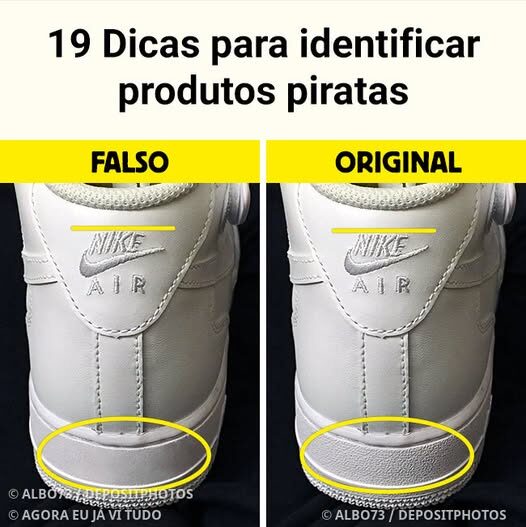
Nike (Focus on Nike Air Tech)
Nike remains the most heavily counterfeited apparel brand worldwide. Replicating the exact structural integrity of genuine Nike sneakers requires heavy investment in specialized industrial molds and proprietary materials.
- Leather and Texture Resilience: Authentic Nikes utilize premium leather grades or highly engineered synthetic meshes. Touch the upper paneling: genuine pairs feature a distinct structural firmness and density. Fake variants tend to use cheap, thin pleather that creases instantly or feels unnaturally spongy.
- Symmetry and Proportions: Place the shoes side-by-side on a level surface. Inspect them from the rear angle. The height of the heel collars, the alignment of the pull tabs, and the angle of the iconic Swoosh must be mirrors of one another. Any slight deviation in panel thickness or crooked stitching points directly to a low-tier batch factory.
Fila (Focus on Complex Stitching)
Fila’s resurgence in streetwear has made its chunky footwear silhouettes prime targets for replica factories.
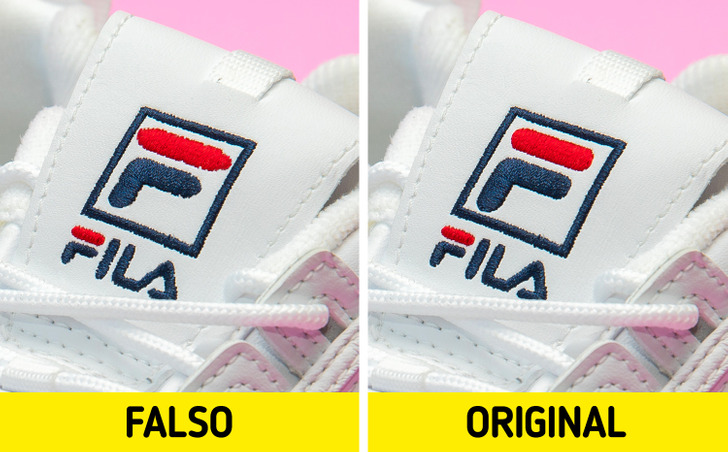
- The “F” Logo Geometry: Examine the iconic Fila “F” embroidery or printed panels. On authentic pairs, it is completely normal to notice tiny, subtle variations along the standard stitching tracks. However, pay close attention to the top dual edges of the letter “F”. Replicas frequently feature overly sharp, needle-like tips that bleed or touch the outer border box. Real pairs maintain a strict, calculated clearance zone around the logo.
- Toe Box Perforations: Look closely at the ventilation holes on the front toe box. Authentic pairs are stamped with identical distance intervals and perfectly uniform circular dimensions. Counterfeiters often punch these holes manually or with misaligned machinery, resulting in uneven spacing and irregular hole shapes.
- Heel Branding Construction: Turn the shoe to check the heel counter. Genuine Fila pairs feature a heel logo that perfectly matches the tongue patch in terms of font weight and clean finishing. Counterfeits frequently utilize a cheap, separate patch piece stitched haphazardly over the leather, sometimes with mismatched red and blue thread tones.
2. Luxury Accessories & Eyewear
Ray-Ban Sunglasses
Ray-Ban eyewear is synonymous with premium craftsmanship. While high-end fakes look convincing, they cannot hide their production methods upon close physical inspection.
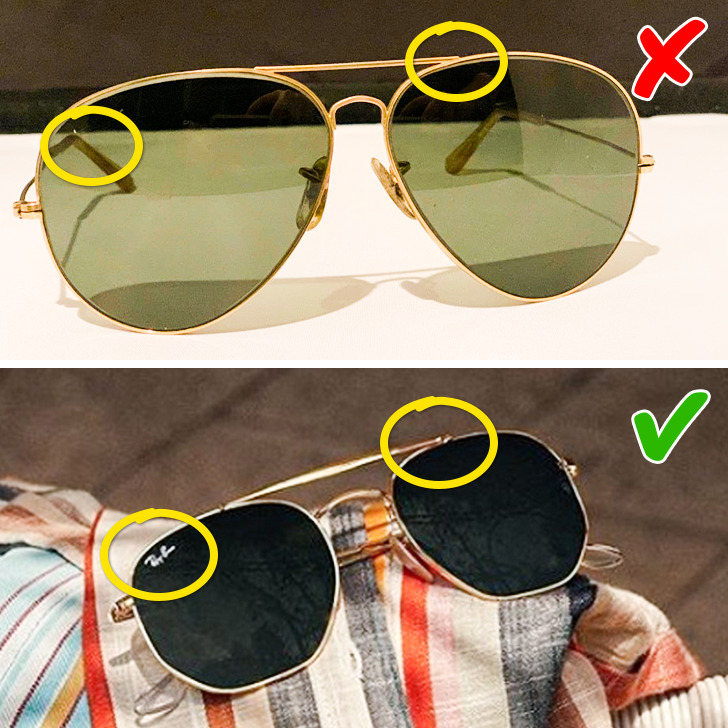
- Seamless Frame Construction: Authentic plastic (acetate) Ray-Ban frames are cut and polished from a single, continuous sheet of high-quality acetate. There should be absolutely no visible molding lines, sharp seams, or rough plastic flashing along the top edges of the frames. Metal variations feature flawlessly smooth, soldered joints with no bulky or bubbling solder residue.
- The Glass Element: The vast majority of standard Ray-Ban classic collections (like the iconic Aviator or Wayfarer) utilize genuine, mineral glass lenses. Glass is cold to the touch and rings cleanly when lightly tapped with a fingernail. If the lenses feel warm, scratch easily, or flex like cheap plastic without a specific lightweight resin designation from the official catalog, proceed with caution.
- The Micro-Etchings: Examine the upper right quadrant of the right lens. The “Ray-Ban” script logo is crisply pad-printed onto the surface and cannot be easily scraped off. More importantly, turn the glasses to look at the left lens: authentic pairs feature a pristine, microscopic “RB” laser engraving on either the outer or inner side of the glass. Counterfeits either omit this completely or apply a messy, thick white paint stencil instead.
Burberry Scarves
The British fashion house is renowned for its heritage textiles, specifically its signature Nova Check cashmere scarves.
- Weave Density and Line Alignment: A genuine Burberry scarf features a tightly woven fabric with a dense, weighted drape. The signature check pattern lines are mathematically perfect, laser-straight, and entirely uniform across the fabric surface. Fakes often feel thin, rough to the touch, and show wavy, blurred, or bleeding pattern lines.
- Fringe Tassels: Inspect the fringe edges. Authentic tassels are expertly hand-rolled, tightly spun, and individualistically secured. They do not unravel or fray easily when gently rolled between your fingers. Counterfeit fringe lines are often flat, loosely twisted, and break away into messy threads with minimal handling.
- The Typography Test: Look at the woven fabric label stitched onto the edge. The word “BURBERRY” must be rendered in crisp, perfectly spaced capital letters with clean serifs. The tag must explicitly detail the fabric composition (e.g., 100% Cashmere) and state the authorized country of origin.
Gucci Handbags
Gucci leather goods represent pinnacle luxury, meaning every millimeter of the bag must pass intense quality control.
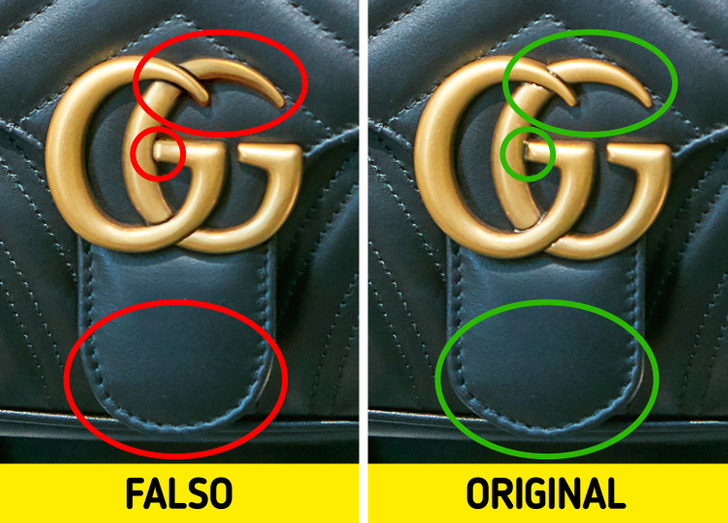
- The Interlocking GG Hardware: The front metal hardware featuring the interlocking “GG” logo is the ultimate telltale sign. On an authentic piece, the serifs (the structural accents at the tips of the letters) must be elongated, elegant, and sharply defined. The rounded curves of the letters must form a perfect, symmetrical oval rather than a blunt circle or a distorted point. The metal hardware should feel heavy, dense, and finished with flawless, smooth plating that is free of pitting or micro-bubbles.
3. Core Blueprint for Savvy Buyers
When shopping online or via secondary marketplaces, protect your investment by deploying these three foundational rules:
- Analyze the Serial Codes: Luxury goods feature highly specific tracking codes (e.g., Gucci’s heat-stamped interior leather tags or Ray-Ban’s temple arm product codes). Cross-reference these serial numbers directly with official product databases or trusted authentication platforms to ensure the style matches the physical piece.
- Verify the Source and Price: If a deal looks too good to be true, it almost always is. Deeply discounted premium goods sold outside of authorized flagship networks or vetted luxury consigments are red flags.
- Audit the Stitching Quality: High-end brands use heavy-duty, bonded threads with high stitch-per-inch counts. Genuine stitching is perfectly uniform, angled slightly diagonally, and locked tight. Fake items exhibit loose loops, straight machine tracking, and messy, un-clipped hanging threads.