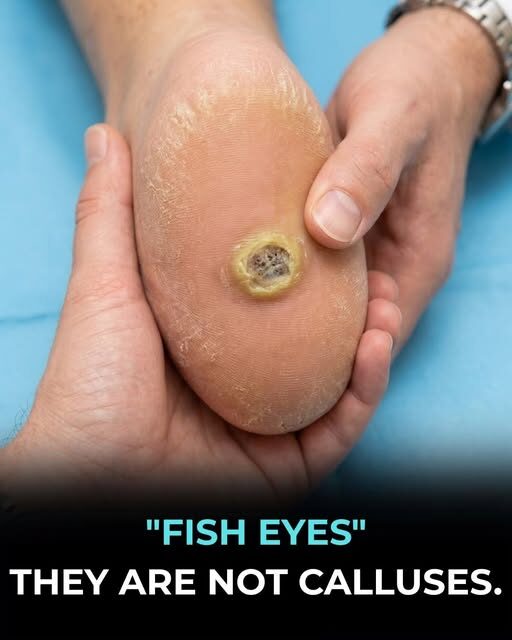
When a painful, hardened bump develops on the bottom of your foot or between your toes, most people reach for a pumice stone or a standard callus plaster, assuming it’s just a buildup of dead skin from tight shoes. However, there is a distinct, often agonizing foot condition commonly nicknamed “fish eyes” (known medically as plantar warts or deep corns) that is frequently misidentified—and treating it like a normal callus can actually make it worse.
Learning to spot the difference between a simple friction bump and a “fish eye” is the first step toward getting the right relief.
What Exactly Is a “Fish Eye” on the Foot?
The term “fish eye” is a colloquial name used in various cultures to describe a specific type of foot lesion that features a hard, yellowish outer ring with a distinct, dark pinpoint center, closely resembling the eye of a fish.
Depending on the exact root cause, a “fish eye” usually turns out to be one of two things:
1. Plantar Warts (Verrucas)
This is the most common culprit behind the “fish eye” appearance. Unlike calluses, which are caused by mechanical friction, plantar warts are a viral infection caused by the Human Papillomavirus (HPV) entering through tiny breaks in the skin. The distinct black dots in the center aren’t dirt; they are tiny, clotted blood vessels (thrombosed capillaries) that have grown up into the wart to supply it with blood.
2. Seed Corns or Deep Helomas
Less commonly, a fish eye can be a deep, localized corn. While standard calluses spread out flat over a wide area, a corn concentrates pressure into a sharp, cone-shaped wedge that points inward toward the deeper layers of skin and nerve endings.
How to Tell the Difference: Callus vs. Fish Eye
Treating a viral wart or a deep corn by aggressively filing it down like a callus can cause severe pain, bleeding, or spread the virus to other parts of your foot. Here is how to tell them apart:
| Characteristic | Standard Callus | “Fish Eye” (Plantar Wart / Deep Corn) |
|---|---|---|
| Center Appearance | Uniform, flat, yellowish thickened skin. | Has a distinct central core, often with tiny black dots. |
| Pain Trigger | Hurts when you press directly down on it. | Hurts significantly more when you squeeze it from the sides. |
| Skin Lines | The natural lines of your footprint run right through it. | The footprint lines fracture or swerve around the bump. |
| Contagion | Not contagious at all. | Highly contagious (if it is a viral plantar wart). |
🚨 The Danger of the Pumice Stone: If your bump is a viral plantar wart, using a foot file or pumice stone can create microscopic cuts that shed the virus. This not only spreads the warts across your own foot but can also contaminate your shower floor, putting family members at risk.
Safe Ways to Manage and Treat Them
Because “fish eyes” root themselves deep into the tissue or are viral in nature, they require targeted treatment rather than surface-level scrubbing:
- Salicylic Acid Treatments: Over-the-counter liquids or patches containing salicylic acid work by gradually peeling away the infected or hardened layers of skin.
- Cryotherapy (Freezing): Doctors can use liquid nitrogen to freeze the lesion, causing it to blister and eventually fall off from the root.
- Professional Podiatry Care: If the bump is a deep seed corn, a podiatrist can safely remove the hard central plug in a sterile environment, providing instant, painless relief.
If your foot bump is changing color, bleeding, causing a limp, or if you have an underlying condition like diabetes or poor circulation, skip the home remedies entirely and consult a podiatrist immediately to avoid serious complications.